
Welcome to WordPress. This is your first post. Edit or delete it, then start writing!
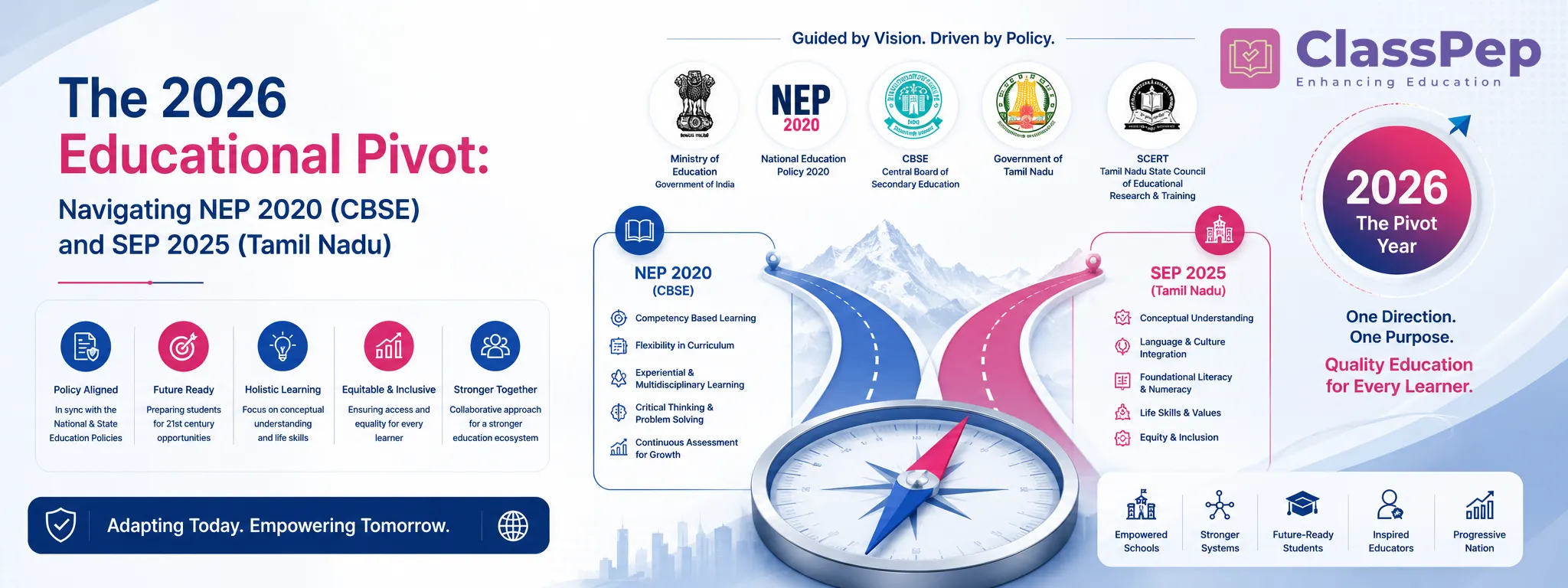
As we step into the 2026-27 academic session, the Indian K-12 landscape is witnessing its most significant transformation in decades. For school leaders, the challenge is no longer just “going digital”, it’s about aligning with two distinct, high-impact frameworks: the National Education Policy (NEP) 2020 for CBSE schools and the State Education Policy (SEP) 2025 for Tamil Nadu Board schools.
At Cloudsky Technologies, we’ve spent the last year refining ClassPep to ensure your institution stays ahead of these changes, regardless of your affiliation.
For CBSE schools, 2026 marks the full-scale implementation of the National Curriculum Framework (NCFSE).
The Three-Language Formula (Class 6): Starting this session (2026-27), Class 6 students must study three languages, two of which must be native to India. Notably, English is now categorized as a “foreign” language option, reflecting a shift toward regional linguistic pride.
Dual Board Exams: To reduce “high-stakes” pressure, CBSE is transitioning to a system where students can take board exams twice a year (main in February/March and optional in May), keeping the best score.
Competency-Based Learning: Rote memorization is out. Exams now focus on core capacities and critical thinking.
Tamil Nadu has introduced its own State Education Policy (SEP) 2025, which offers a localized alternative to the national framework.
The Two-Language Stronghold: Unlike NEP’s three-language push, TN remains firmly committed to a two-language policy (Tamil and English) to preserve regional identity.
Assessment Shifts: TN has moved away from public exams for Classes 3, 5, and 8, favoring internal assessments to reduce early student stress. Additionally, the Class 11 public exam was recently abolished to allow a more integrated focus on the Class 12 Boards.
Early Schooling: While NEP starts Class 1 at age 6, the TN model maintains entry at age 5, focusing heavily on play-based Child Development Centres.
Whether your school follows the 5+3+3+4 (NEP) or the 5+3+2+2 (SEP) structure, your administrative load has likely tripled. ClassPep is built to solve these exact 2026 pain points:
Holistic Progress Cards (HPC): Ditch the old mark sheets. ClassPep generates 360-degree digital report cards that track cognitive, social, and creative development, as mandated by both policies.
Multilingual Communication: With the new focus on Indian languages, ClassPep’s communication module supports regional language integration, allowing you to engage parents in their mother tongue.
The 2026 academic year isn’t just about new textbooks; it’s about a new pedagogical philosophy. Schools that leverage smart technology like ClassPep won’t just “comply”, they will lead.
Ready to future-proof your school for the 2026-27 session?
Contact classpep to book a demo.