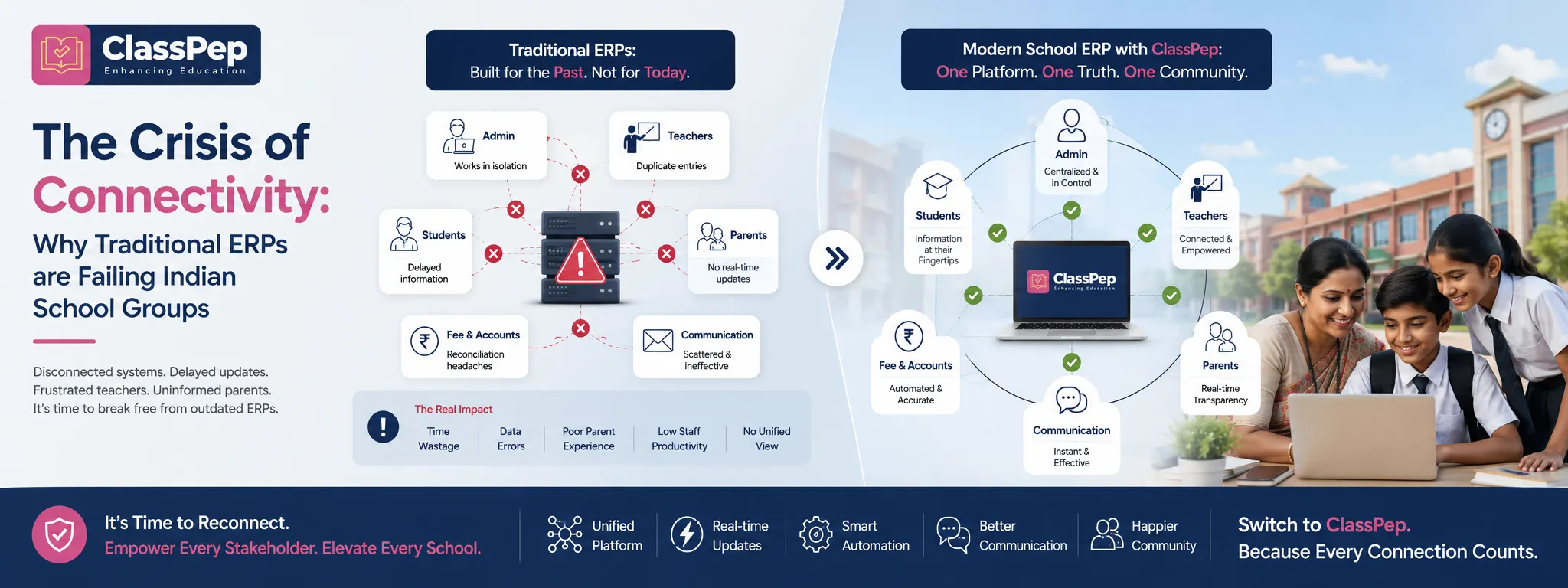
In the competitive landscape of Indian K-12 education, growth is often a double-edged sword. As a single school evolves into a Group of Schools, the complexity of management doesn’t just add up, it multiplies.
For many Trustees and Managing Directors, the dream of expansion often turns into a nightmare of fragmented data, rising overheads, and “Siloed Management.”
The “Silo Trap”: Identifying the Pain Points
Most schools today are “digital,” but few are “integrated.” Traditional ERPs often act as glorified digital filing cabinets rather than active management partners. This leads to three critical pain points:
1. The Multi-Campus Visibility Gap
When managing a group of schools, the biggest challenge is the lack of a “Single Source of Truth.” If the Chairman needs to compare the fee collection or teacher attrition rates between a branch in Bangalore and one in Delhi, it often takes days of manual Excel consolidation.
- The Pain: Delayed decision-making and financial leakage.
2. Operational Friction in Logistics
Transport and Inventory are often treated as “afterthoughts” in software design. When a student’s address changes in the academic records but doesn’t sync with the School Bus Tracking System, it creates a safety risk and parental anxiety.
- The Pain: High “hidden costs” in fuel, inventory wastage, and brand reputation damage.
3. Faculty Burnout vs. Academic Excellence
Teachers in India spend nearly 30% of their time on administrative tasks (attendance, manual grade entry, report card generation). This is time stolen from pedagogical innovation and student mentorship.
- The Pain: High teacher turnover and stagnating academic results.
Moving Toward Adaptive School Management
The solution isn’t just “more software”—it is an Adaptive Ecosystem.
According to the National Education Policy (NEP) 2020, Indian schools must move toward data-driven teaching and holistic assessment. This is impossible if your data is stuck in silos.
Why “Adaptive” is the New Gold Standard
An adaptive system, like ClassPep, doesn’t just store data; it makes data work for you.
- Integrated Workflows: Imagine a system where a fee payment automatically updates the student’s digital ID, grants library access, and notifies the transport manager.
- Unified Academic Planning: Standardize curriculum and exams across 50 campuses with a single click, ensuring brand consistency.
- Predictive Analytics: Use AI to identify students at risk of falling behind or campuses that are exceeding their operational budgets before the month ends.
The Strategic Path Forward
For the modern Indian School Leader, the goal is Operational Excellence. Transitioning to an adaptive management system is no longer a luxury—it is a prerequisite for scaling.
The question isn’t whether your school is digital. The question is: Is your system talking to itself, or are your staff doing all the talking for it?